Risk of Rain 2 turns dying into a language you slowly learn
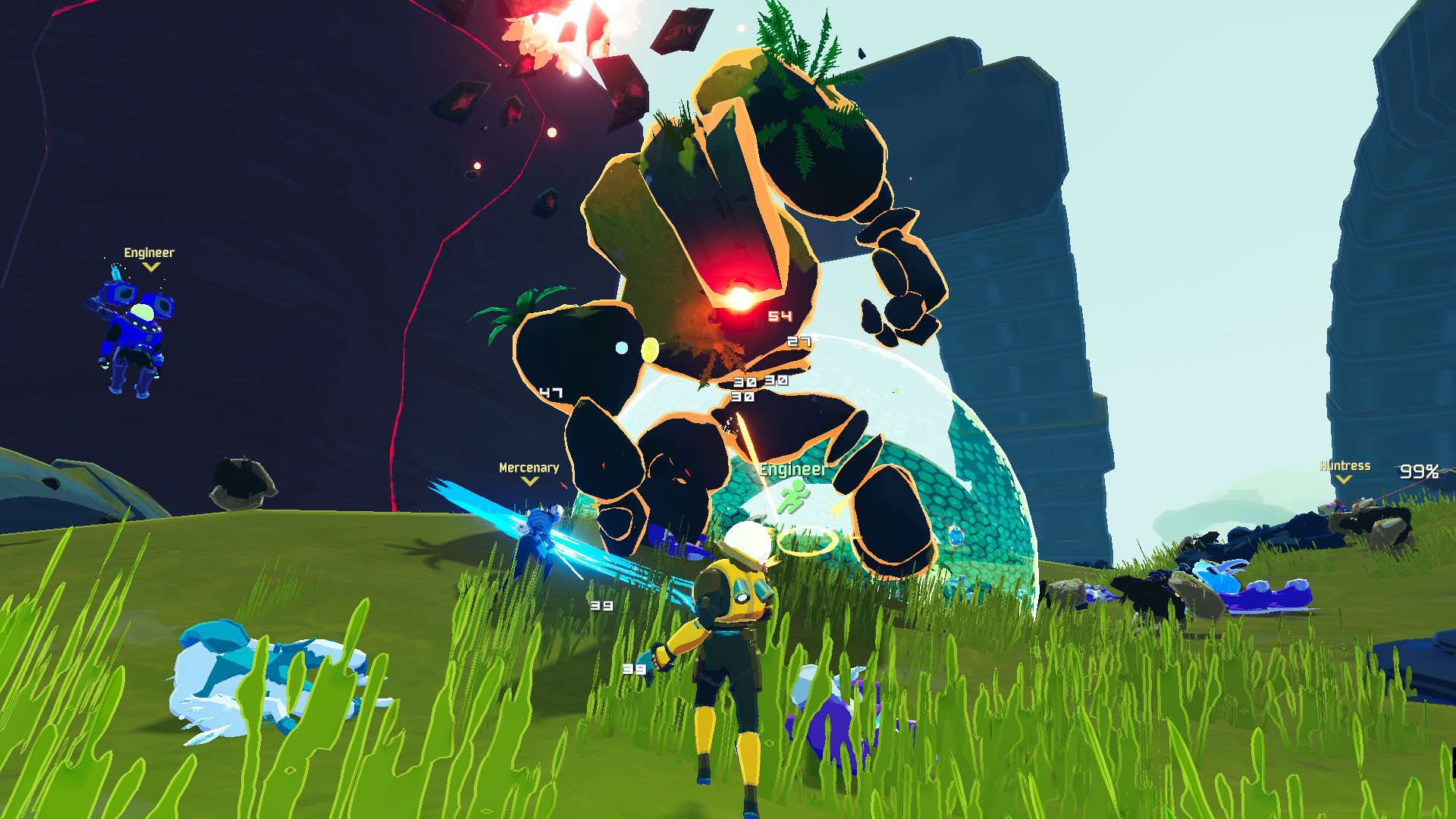
Risk of Rain 2 is one of those games that does something genuinely difficult: it makes failure feel like progress without ever explicitly telling you it does. There's no XP bar ticking up, no meta-upgrade screen promising you'll be stronger next run. You just die — maybe at the third Teleporter event, maybe embarrassingly early on Drizzle — and then you go again, and somehow the next run feels a little less chaotic. That accumulation of spatial knowledge, enemy pattern recognition, and item synergy awareness is the game's real progression system. It just lives in your head instead of a save file.
Hopoo Games' 2019 roguelite — which graduated from Early Access with a content arc that kept expanding well into 2021 and beyond — sits in a specific genre pocket that's harder to occupy than it looks. Too punishing and it alienates everyone except the committed few. Too forgiving and the tension that makes each run feel meaningful evaporates. Risk of Rain 2 threads this more carefully than most comparable games, though not without the occasional rough edge. It lands somewhere between comfort food and a genuine mechanical workout, depending partly on how much you're willing to read item descriptions.
The third dimension does real work
The original Risk of Rain was a 2D side-scroller, and making the sequel a full third-person action game could have been an excuse to lose what made the first game interesting. Instead, the 3D space actively reshapes the design. Enemy attacks have physical trajectories you can dodge around. The maps — each procedurally assembled from handcrafted pieces — have verticality that matters. Playing Loader, a melee brawler who can grapple across entire arenas, feels nothing like playing Artificer, who needs careful positioning to land AOE damage without pulling too many enemies at once. That class differentiation is partly stat-based, but mostly it's architectural: each survivor moves through the same environment in a different way.
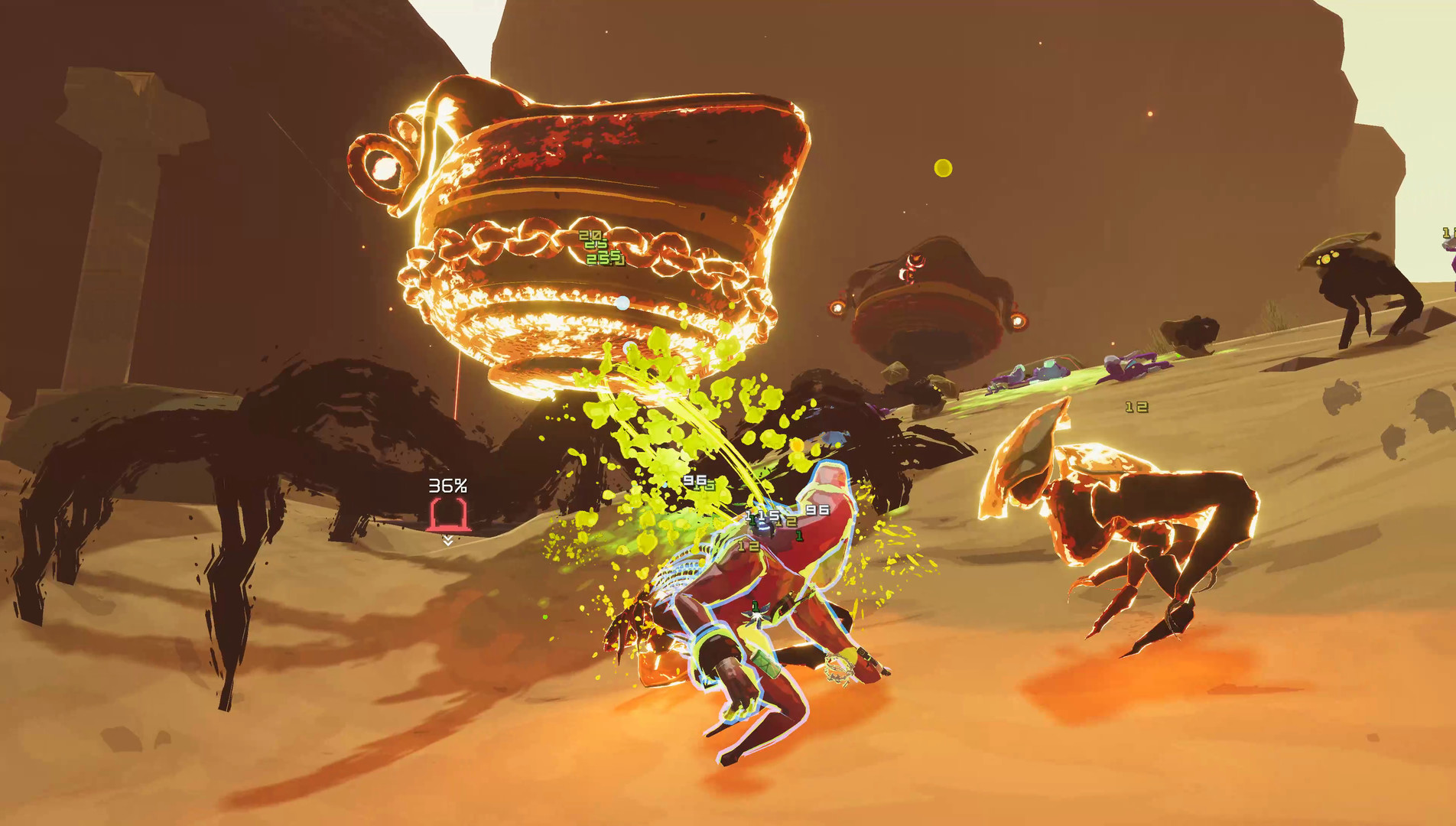 Scene from Risk of Rain 2.
The camera takes some adjustment, especially in enclosed spaces where enemy density spikes fast. And some stages — Siren's Call in particular — have sightline issues that feel more like a level design oversight than an intentional challenge. But these are minority complaints. Most of the time, the spatial design earns its difficulty through deliberate construction rather than cheap ambushes.
Items are the grammar of each run
Risk of Rain 2 has well over a hundred items, and understanding how they interact is essentially the whole meta-game. Some synergies are obvious once you notice them: stack enough Soldiers Syringes (which boost attack speed) with Gasoline (fire on kill) and Fuel Cells (extra equipment charges), and you can sustain ignition chains that kill entire rooms before you've consciously aimed. Others are stranger. The Gesture of the Drowned, which auto-activates equipment on a shortened cooldown, turns certain loadouts from useful into broken — sometimes in your favor, occasionally in a way that detonates you mid-run.
The problem — if you want to call it that — is that these interactions are almost entirely self-discovered. The game provides brief item descriptions, not tutorials. New players picking up Fuel Cells and Transcendence in the same run without understanding the shield-HP trade-off will often not survive long enough to learn why. Compared to something like Hades, where Supergiant front-loads enough contextual dialogue that mechanical explanations feel organic, Risk of Rain 2 is notably unsentimental about your learning curve. Some people find that liberating. Others bounce off it before the vocabulary clicks.
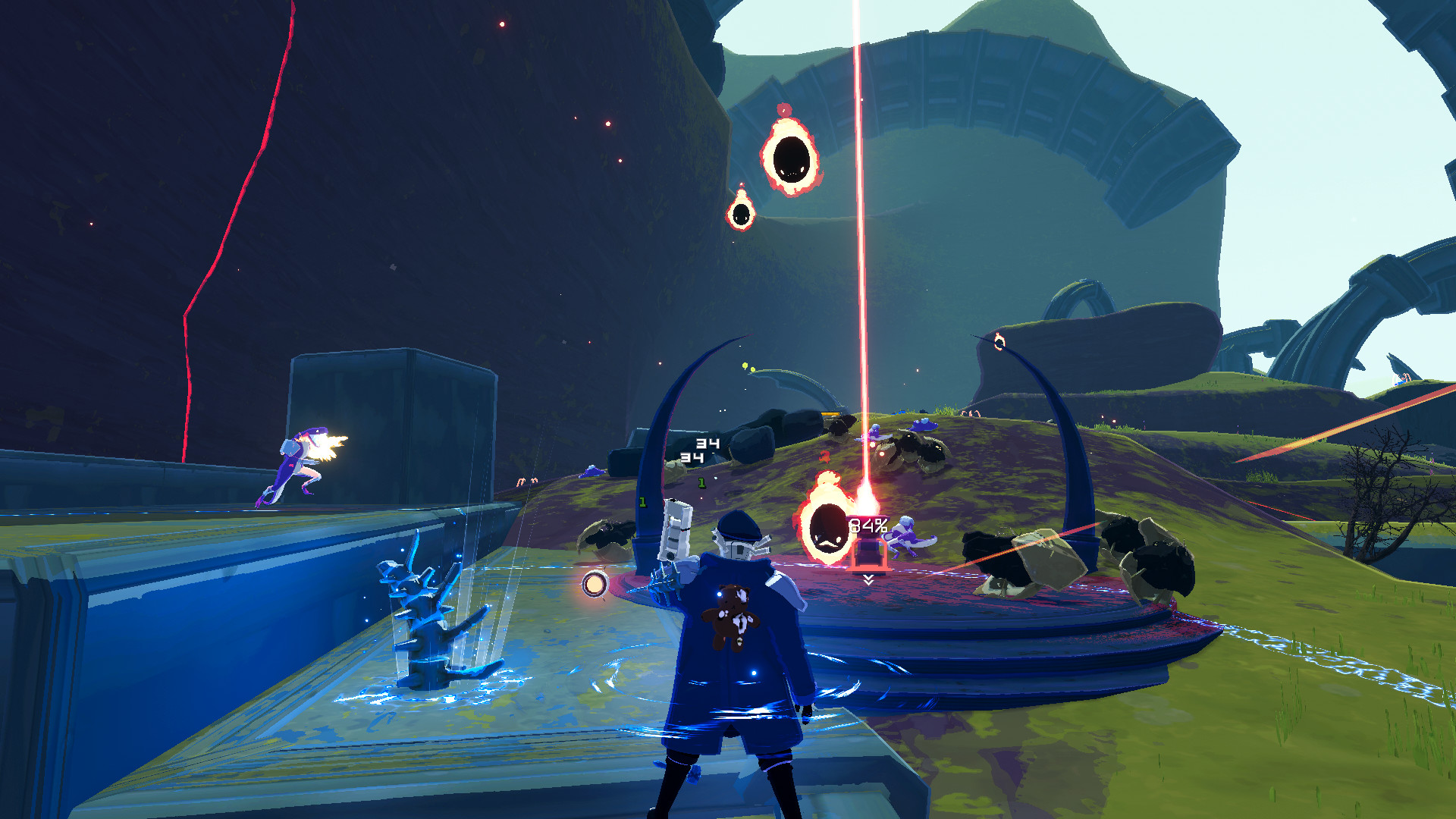 Scene from Risk of Rain 2.
Difficulty scaling that earns its tension
The game's time-based difficulty is one of its more quietly elegant mechanics. Instead of fixed difficulty tiers per run, every stage gets progressively more dangerous the longer you spend on it — enemies hit harder, move faster, and spawn more densely. A relaxed scavenging loop on the first stage becomes a sprint by the second. You're not just collecting items; you're constantly calculating whether one more chest is worth the extra exposure. That decision, repeated dozens of times per run, is where most of the tension actually lives.
Monsoon — the hardest standard difficulty — turns this tension into something close to a pressure cooker. The elite variants of enemies that appear on higher difficulties don't just have more health; they have status effects and movement behaviors that demand specific responses. A glacial Elder Lemurian in an enclosed corridor on Monsoon will teach you very quickly where the stage geometry's blind spots are. Whether that's satisfying difficulty or punishing design probably depends on your patience, and I won't pretend there's a clear answer. What I'll say is that the game is measurably better once you're playing on at least Rainstorm, where the stakes are high enough that itemization choices feel consequential.
Multiplayer shifts everything — mostly for the better
Risk of Rain 2 is a functional solo experience, but four-player co-op is where the game shows a different face. Item stacking compounds across the party, enemy health scales upward, and the visual chaos of four survivors running conflicting builds in the same corridor is — depending on your perspective — either exhilarating or a complete mess. Loader grappling through a Wandering Vagrant's lightning field while an Acrid player corrodes everything in the background and a MUL-T is somehow running two equipment items simultaneously is legitimately funny to watch, in a way that solo runs rarely produce.
The co-op scaling isn't perfectly tuned — bosses can become damage sponges at four players in a way that drags pacing — but the social layer of comparing item loadouts mid-run, debating whether to rush the Teleporter or keep clearing, adds a dimension the game can't replicate alone. There's a specific texture to multiplayer Risk of Rain 2 that reminds me, loosely, of the co-op mode in Spelunky 2: the collaboration is genuine, but so is the chaos, and neither cancels the other out.
What the DLC adds and what it doesn't fix
The Survivors of the Void DLC, released in 2022, brought two new survivors — Void Fiend and Railgunner — plus the Void Fields and Planetarium stages. Railgunner is an excellent addition: a precision-aiming survivor whose scope mechanic adds a targeting discipline that none of the base game characters require. She's harder to play well, but the mechanical gap between competent and excellent play is visible in a satisfying way. Void Fiend is more interesting as a concept than in execution — the corruption-management mechanic reads better in theory than it feels in a high-speed run — though I acknowledge that's a minority view among dedicated players.
The Void-themed content also introduced Void Cradles, which trade max health for a guaranteed item drop — a risk calculus that integrates cleanly with the base game's existing pressure. The new stage environments are visually distinct, if slightly less readable than the original biomes. None of the DLC content breaks anything that worked, which at minimum clears the bar that some expansion packs fail to.
Who this game is actually for
Risk of Rain 2 rewards a specific mindset: curiosity about systems, tolerance for opacity, and the willingness to treat a bad run as data rather than waste. If you came in expecting the gentle onboarding of Dead Cells or the narrative momentum of Hades, you might find the first few hours sparse. The game doesn't offer story as a scaffold. It offers mechanics, and it trusts you to find the meaning in mastering them.
That trust is, honestly, refreshing. A lot of modern roguelites over-explain themselves, front-loading tutorials that feel like apologies for complexity. Risk of Rain 2 doesn't apologize. It drops you into Petrichor V with a character you don't fully understand, against enemies whose behaviors you'll misread for several hours, and it waits. The vocabulary accumulates. Eventually you stop dying at stage three and start dying at stage five, and then you realize — not from a prompt, but from your own muscle memory — that you've learned something.
That quiet transfer of knowledge from the game to the player, without ceremony or hand-holding, is what Risk of Rain 2 does better than almost anything else in the genre. It's not a perfect game — the difficulty curve has real rough patches, some survivors remain underdeveloped, and the late-loop content can feel thin if you're past a certain mastery threshold. But as a design argument for trusting your player? It holds up in a way that's harder to argue with the more hours you put in.
Editorial scoring
Reader Q&A
How long does it take to finish Risk of Rain 2 turns dying into a language you slowly learn?
Main story runs around 18 hours depending on how thoroughly you explore. Completionists can spend 2-3× that.
Is Risk of Rain 2 turns dying into a language you slowly learn good for newcomers to 3D Roguelite?
For total newcomers, expect a 5-8 hour ramp-up. Once you internalize the loop, it clicks.
Which platform should I play Risk of Rain 2 turns dying into a language you slowly learn on?
Steam Deck handles this title well — verified compatibility on most recent patches.
Was Risk of Rain 2 turns dying into a language you slowly learn worth the launch-day price?
If you're a fan of Hopoo Games, yes. If you're new to the studio, a sale price is more comfortable.
Are there DLCs or expansions worth picking up?
The base game is complete; expansion DLC adds 10-15 hours of additional content if you want more.
What did Hopoo Games get right (and what could be better)?
Strongest: art direction, audio design, set-piece variety. Weakest: late-game balance and a few persistent quest-log bugs.
Reader comments