Spider-Man 2 swings bigger — and mostly sticks the landing
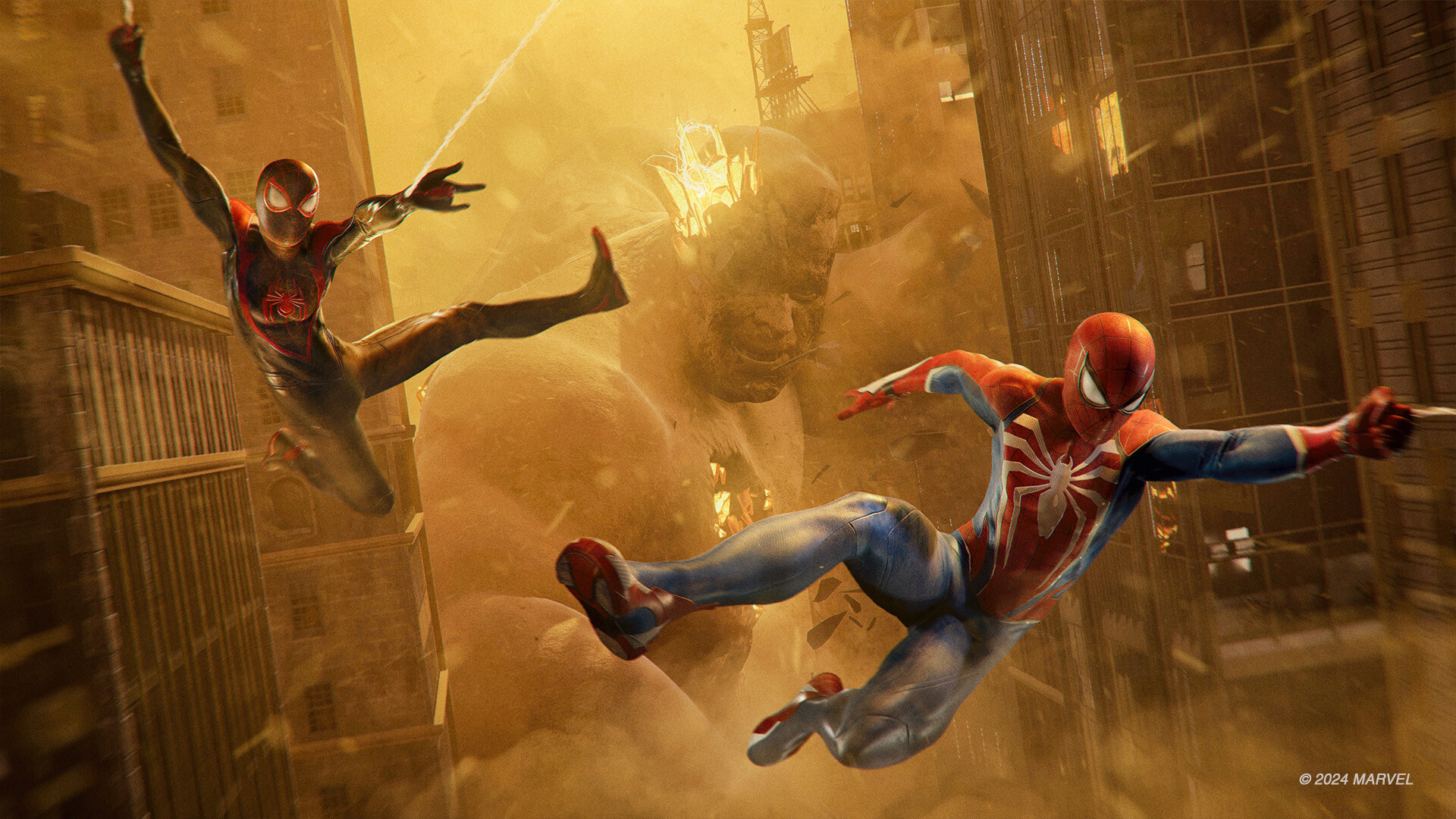
Insomniac Games did not make a cautious sequel. Marvel's Spider-Man 2 arrives on PS5 stuffed with content, character-swapping mechanics, a villain roster that would embarrass most superhero films, and a city that has physically grown to include Queens and Brooklyn alongside the original Manhattan. It is, by most measurable criteria, more: more map, more abilities, more story beats, more suits, more side missions than any reasonable person will finish on their first run. Whether 'more' was the right answer depends heavily on what you found compelling about the first game — and how you feel about a sequel that sometimes sprints past its own best ideas.
The 2018 original worked partly because it was restrained in ways that felt deliberate. The city was dense but navigable. The story kept Peter Parker's civilian life in genuine tension with the mask. Spider-Man: Miles Morales, which came after, was leaner still — a shorter game with better pacing and a more focused emotional argument. Spider-Man 2 inherits the ambition of the first and the emotional stakes of the second, then tries to run both simultaneously. Mostly it succeeds. But the seams are visible.
Traversal Is Still the Core of Everything
The web-wing gliding mechanic is the single biggest quality-of-life addition in the game, and it earns its place. Holding L3 mid-swing deploys a wingsuit that lets you cover horizontal distance fast enough to make the expanded map feel like an asset rather than a chore. Wind tunnels scattered across the borough rooftops give you altitude boosts, and chaining a tunnel into a swing into a web-zip becomes the kind of fluid movement language you stop consciously thinking about after a few hours. Insomniac clearly spent serious time here.
 Atmospheric detail in Marvel's Spider-Man 2.
What the web-wings also do, perhaps unintentionally, is reduce the city to a backdrop. The original game's Manhattan rewarded low-altitude swinging — there were gaps between buildings that punished inattention, line-of-sight moments that made you feel like you were actually reading architecture. The expanded map in Spider-Man 2 is broader and more visually varied, but the web-wings mean you can bypass most of it at altitude. Players who prefer the ground-level rhythm of classic wall-crawling will find that option still available, but it is no longer incentivised by the design the way it once was.
Two Spider-Men, One Complicated Structure
The game splits its main campaign between Peter Parker and Miles Morales, with the player-facing switch mechanic available during open-world exploration. In missions, the game assigns its protagonist. Both characters have meaningfully distinct combat kits: Miles brings his bioelectric Venom powers and camouflage, while Peter's base moveset is supplemented first by his mechanical arms and then, after the symbiote storyline kicks in, by Venom-adjacent black-suit abilities. On paper this is exciting. In practice, the game's pacing treats the two protagonists unevenly.
Peter's arc — the black suit, the creeping behavioural shift, the eventual rejection — gets the majority of the dramatic heavy lifting. Miles' storyline is genuinely affecting in its own right, particularly around his relationship with his late father and his responsibilities to his neighbourhood, but the game keeps cutting away from it at the wrong moments. There are stretches in the middle third where Miles feels like he is maintaining a subplot while Peter carries the main event. Given that Miles Morales the standalone game proved he can anchor a complete narrative, this feels like an opportunity the writers only half-took.
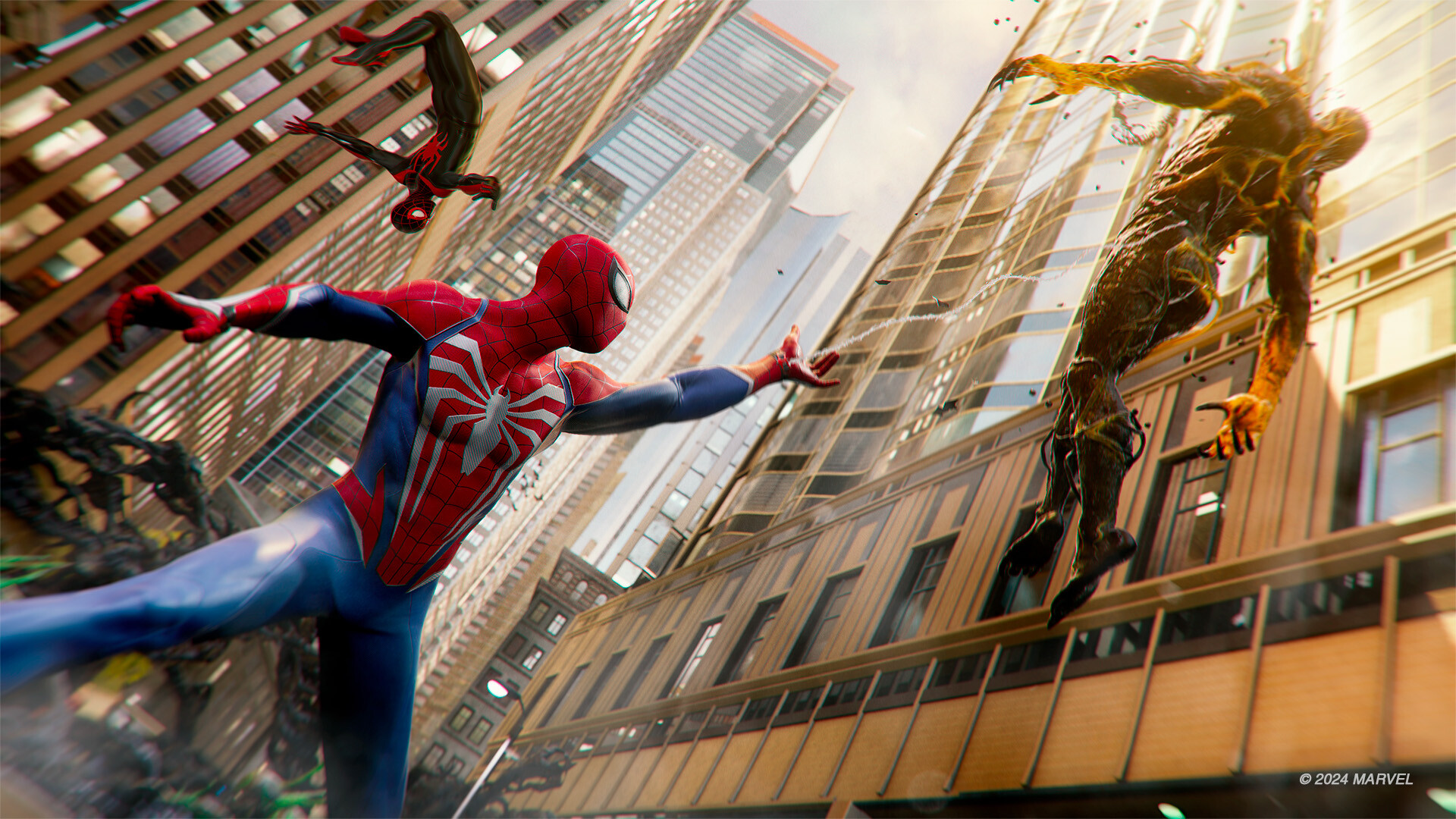 Combat encounter in Marvel's Spider-Man 2.
Kraven, Venom, and the Villain Problem
Spider-Man 2 commits fully to a two-villain structure, with Kraven the Hunter arriving in New York to pursue his own deadly agenda while the symbiote threat builds in parallel. Kraven is the more interesting narrative device: his obsession with hunting worthy prey generates most of the game's best set-pieces and gives the supporting cast — Martin Li, the Lizard, Sandman — something more interesting to do than stand around as boss-fight checkpoints. His design is also one of the game's strongest visual choices, lean and methodical in a way that contrasts well with the symbiote's visual chaos.
Venom, when he fully arrives, is spectacular in the way blockbuster games have trained us to expect: loud, visually overwhelming, with a voice performance from Tony Todd that lends genuine menace to what could have been a CGI-noise character. The problem is structural. The final act compresses dramatically, and both villains end up with less resolution than they deserve given how much of the preceding twenty-odd hours was spent building them. Kraven in particular exits in a way that feels like the writers ran out of runway. It is not a bad ending. It is an ending that needed another hour around it.
Combat: More Systems Than You Will Ever Use
The combat system in Spider-Man 2 is technically generous to a fault. Both characters have full ability trees, unlockable gadgets, and symbiote-specific attacks for Peter during his black-suit chapters. The parry mechanic — new to this entry — adds a timing-based layer that rewards aggression in a way the dodge-heavy system of previous games did not. On harder difficulty settings, managing the parry window against enemy attack chains produces genuinely tense encounters. The arena-style combat challenges scattered around the map are actually worth doing for this reason.
On standard difficulty, though, the systems start to undermine themselves. There are simply too many abilities mapped to too many button combinations, and the game's enemy design rarely forces you to engage with more than a fraction of them. You can complete most story missions on three or four core moves. The skill trees, which require specific challenge completions to unlock faster, end up feeling like administrative tasks attached to a combat system that already works without them. Insomniac built a deep toolkit; the campaign does not consistently demand that you reach for it.
The Player This Game Is Actually Built For
Marvel's Spider-Man 2 is unambiguously designed for players who want a premium single-player spectacle and are content to let the game set the pace. If you are the kind of player who clears every district's side content before advancing the main story — which the game actively encourages through its map-unlock structure — you will spend thirty or more hours here and find it consistently polished. The production values are extraordinary. The web-swinging remains one of the best movement systems in any open-world game, full stop. The suit customisation, if that matters to you, is absurdly comprehensive.
Players who want tighter narrative focus, or who came in specifically for Miles' story, may find the experience more uneven. The game's willingness to pause its own dramatic momentum for a side mission about helping a street artist or recovering stolen keepsakes speaks to a specific design philosophy — keep the player in the world, keep the world populated — that is not wrong, exactly, but is a particular taste. I find myself somewhere in the middle: I stopped doing side content around the fifteen-hour mark because the story had finally found its footing, and I did not want to break the rhythm.
Presentation as an Argument
New York in Spider-Man 2 is a technical achievement worth acknowledging plainly. The near-instant fast travel, the draw distance, the density of civilian geometry during free-roam — these are things the PS5 hardware was presumably purchased to enable, and Insomniac delivers them without qualification. The lighting during the late-game night sequences, particularly around the symbiote-affected areas of the city, pushes into genuinely striking territory. The photo mode, predictably, gets a workout.
The accessibility options are also worth noting explicitly: the game includes an extensive suite of adjustments covering visual contrast, aim assist, difficulty tuning, and traversal automation. The web-swing assist alone — which can smooth out the timing demands of traversal for players who find the manual rhythm frustrating — represents real design consideration rather than a checkbox feature. Insomniac has been consistent on this front across their last three titles, and Spider-Man 2 is their most thorough implementation.
Spider-Man 2 is a game that knows what it is and executes it with confidence. Some of that confidence spills into excess — the bloated middle, the underserved Miles arc, the ability trees that extend past what the game actually demands. But the swinging still sings, the black-suit chapters build genuine dread, and Kraven is a better villain than he had any right to be given his relatively modest cultural footprint. If Insomniac's next entry learns to cut rather than add, they might make something genuinely exceptional. For now, this is very good wrapped around the outline of something better.
Editorial scoring
Reader Q&A
How long does it take to finish Spider-Man 2 swings bigger — and mostly sticks the landing?
Main story runs around 85 hours depending on how thoroughly you explore. Completionists can spend 2-3× that.
Is Spider-Man 2 swings bigger — and mostly sticks the landing good for newcomers to Superhero Action?
It depends. The systems are deep but the tutorial does a fair job. Veterans of Superhero Action will feel at home faster.
Which platform should I play Spider-Man 2 swings bigger — and mostly sticks the landing on?
Steam Deck handles this title well — verified compatibility on most recent patches.
Was Spider-Man 2 swings bigger — and mostly sticks the landing worth the launch-day price?
Depends on backlog. The replay value justifies the price for genre fans; casual players should wait for a 40%+ discount.
Are there DLCs or expansions worth picking up?
Skip the cosmetic DLC. The story expansion is the only one we'd recommend at full price.
What did Insomniac Games get right (and what could be better)?
The systems are confident and the combat is satisfying. The story handoffs and load times are the rough spots.
Reader comments