Mafia III's rage still burns — the repetition nearly doesn't
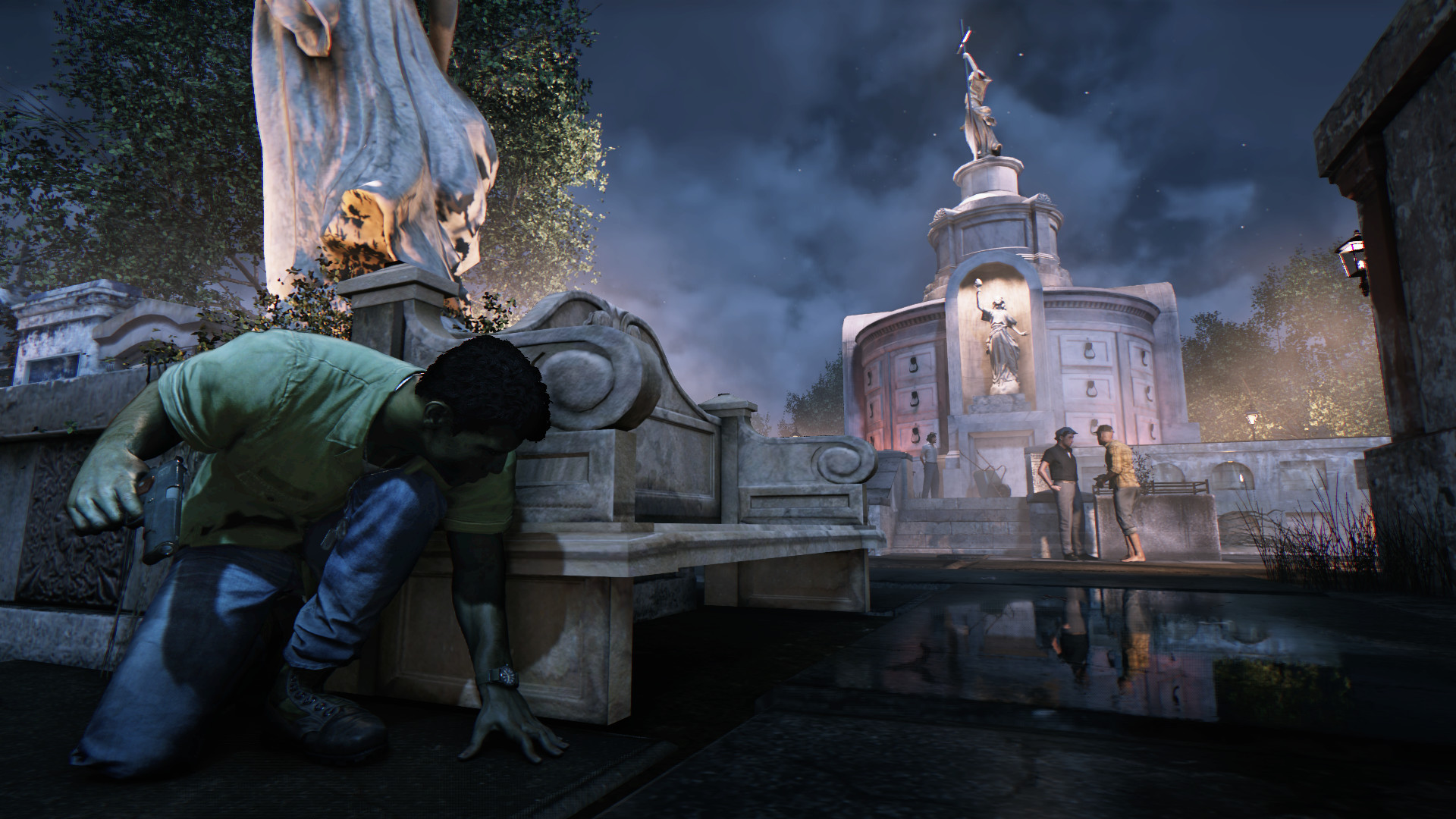
Hangar 13's 2016 open-world crime game arrived into a marketplace that had already decided what a Mafia sequel should look like, and then did something else entirely. Where Mafia II built its identity around a tight, linear narrative with deliberate pacing, Mafia III sprawled outward into a revenge thriller set in a fictionalized 1968 New Orleans — renamed New Bordeaux — and handed you a Black Vietnam veteran named Lincoln Clay as its protagonist. The response at the time was mixed in ways that felt ideologically tangled: some players disliked the game's frank treatment of race, and others had legitimate structural complaints about repetition. Both conversations happened simultaneously, and they were not always easy to separate.
The Definitive Edition, released in 2020, collects the base game with its three story DLCs — Faster, Baby!, Stones Unturned, and Sign of the Times — and a handful of cosmetic additions. It does not fix the repetition problem. What it does do, which matters more than people give it credit for, is preserve one of the most emotionally grounded crime narratives in the genre's history with enough mechanical roughness intact to feel honest rather than sanitized.
New Bordeaux as a setting, not a backdrop
The city is the game's strongest single argument for its own existence. Hangar 13's rendering of late-1960s Louisiana is detailed in ways that go beyond visual dressing. The radio stations track the cultural rupture of the era — you get Creedence Clearwater Revival alongside Nina Simone, and the transition between stations feels like changing channels on a moment in American history rather than shuffling a playlist. The ambient dialogue reacts to Lincoln's presence differently depending on what district you are in and who sees you there. White NPCs in the Frisco Fields suburb will call the police simply because you are walking through. That system is not subtle, but it is purposeful.
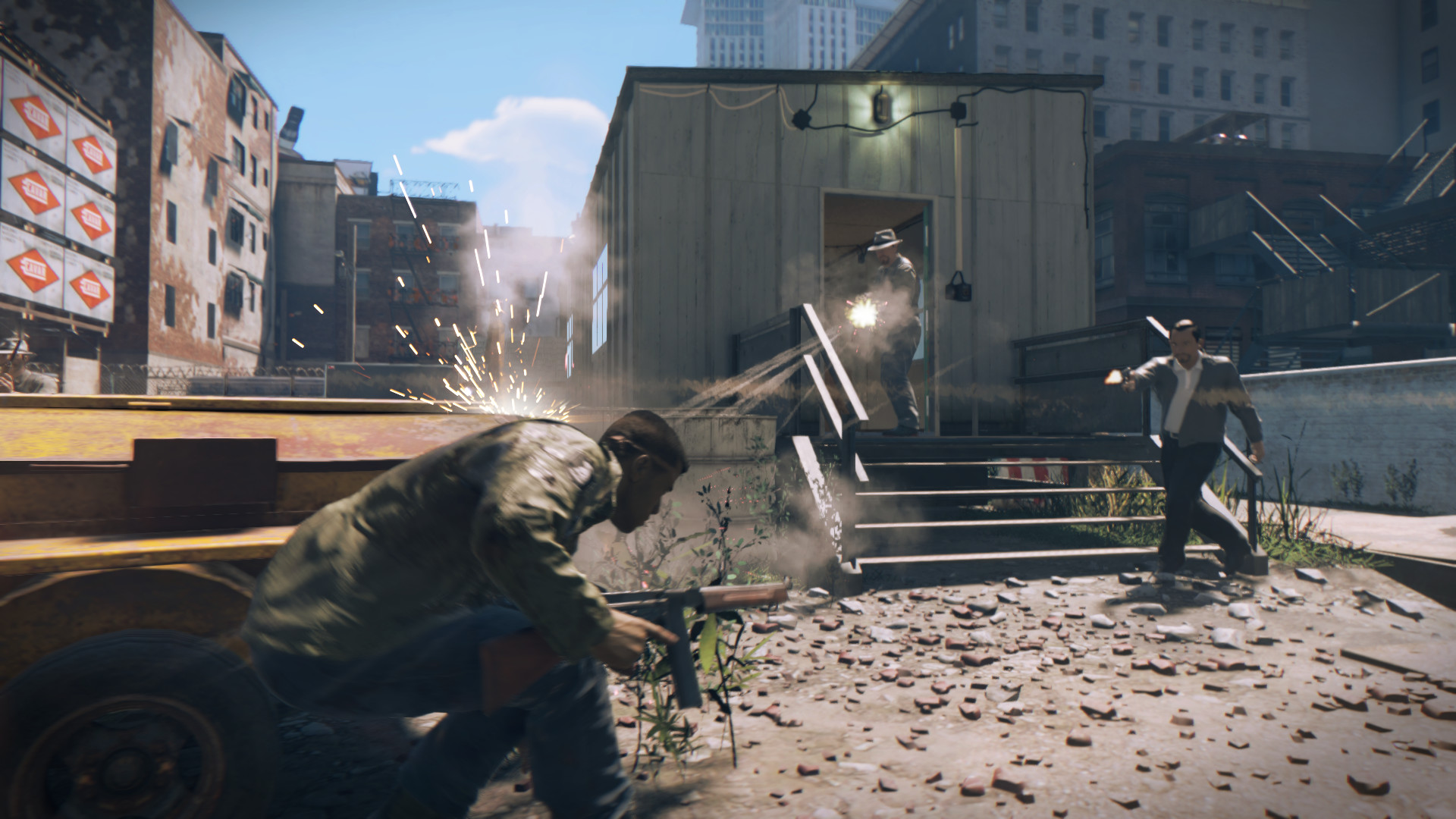 Atmospheric detail in Mafia III: Definitive Edition.
The structural framing — a documentary-style present-day interview format intercut with 1968 gameplay — gives the city a retrospective weight that most open-world games avoid. You already know Lincoln survived. What you do not know, for most of the game, is at what cost. That gap between outcome and journey is where the narrative does its best work, and it keeps the Louisiana bayous, the jazz clubs, and the crumbling riverfront districts feeling like places that mattered rather than zones on a progress checklist.
The combat is better than the discourse suggested
Lincoln handles like someone who learned to kill in a war and never quite stopped thinking that way. The cover system is competent rather than spectacular — it sits somewhere between the rigidity of early Gears of War and the fluid contextual cover in more recent third-person shooters — but the stealth options are more layered than a first pass reveals. Whistling enemies toward you for a takedown, using the trunk of a car to dispose of bodies, calling in your underboss network for supply drops mid-mission: these systems interact in ways that reward players who treat combat as a problem to dismantle rather than a corridor to walk through.
The gunplay itself has a satisfying heaviness that feels appropriate to the era. Weapons do not feel interchangeable. The shotguns have a percussive kick, the suppressors meaningfully change engagement tempo rather than just reducing a sound effect, and the environmental awareness of enemies — they react to bodies, investigate noise sources, send out search patterns — is consistent enough to support genuine tension during longer stealth sequences. It is not Hitman-level sandbox problem-solving, but it is also not as shallow as the 2016 reviews sometimes implied.
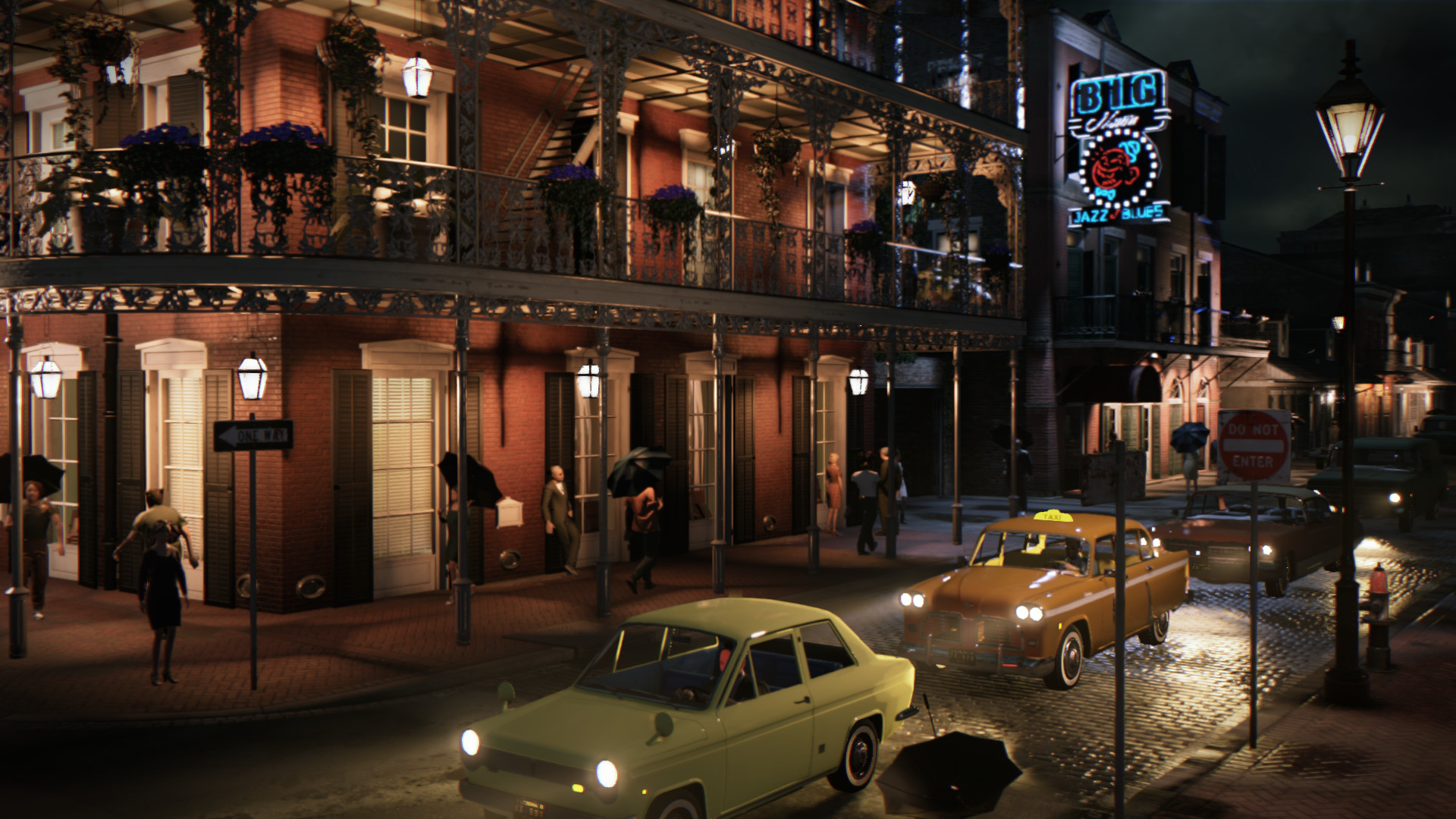 Combat encounter in Mafia III: Definitive Edition.
The repetition problem, stated plainly
Hangar 13 built Mafia III's progression around dismantling the New Bordeaux criminal empire of Sal Marcano by peeling apart his lieutenants district by district. Each district follows the same structural loop: find the underboss controlling that territory, undermine their operation by hitting rackets, then choose which of your three underbosses — Cassandra, Burke, or Vito Scaletta — inherits control. The loop is clean in theory. In practice, hitting three to five rackets per district, across nine districts, using a menu of roughly five or six mission types, starts to compress into a single blurred memory somewhere around the midpoint.
This is not a subjective grievance. The mission variety genuinely does not expand at the rate the map does. By the time you are dismantling the Hollow, you have assassinated enough mid-tier mob accountants to fill a small cemetery, and the game offers little mechanical escalation to match the narrative's rising stakes. It is worth stating this plainly because the repetition is real, and reviews that skip past it do prospective players a disservice. The question worth asking is whether the repetition becomes a disqualifying flaw or a familiar rhythm you can tolerate — and that answer is genuinely individual.
The underboss system earns its place
What keeps the structural loop from complete collapse is the underboss relationship system, which is more consequential than it first appears. Cassandra, Burke, and Vito each have distinct support networks, unlock different perks as their territories grow, and will actively destabilize Lincoln's operation if they feel they are being cut out. This is not window dressing. Neglect Burke long enough and he will start restricting your access to the weapons dealer he controls. The mechanic forces attention to the political texture of Lincoln's alliances rather than treating the underbosses as passive mission-givers.
The three DLC campaigns each use one underboss as a focal point and do interesting things with them. Faster, Baby! takes Lincoln and a civil rights activist named Roxy Laveau into a rural Louisiana county dealing with a corrupt sheriff, and it is probably the tightest of the three in terms of mission structure. Stones Unturned brings back John Donovan, Lincoln's CIA contact, for a Cold War subplot that feels tonally distinct from the main game. Neither expansion is essential, but both add texture to supporting characters who the base game handles efficiently without quite giving them room to breathe.
What the Definitive Edition gets right and what it skips
The Definitive Edition runs cleanly on current hardware and removes the frame-rate cap that plagued the original PC release — a genuine quality-of-life improvement given how much time you spend driving through New Bordeaux's wider streets. The visual upgrades are modest rather than transformative, though the lighting in the game's interior spaces was always better than it got credit for at launch.
What the Definitive Edition does not do is address the pacing in the back half of the main campaign, where the game reaches its dramatic peak around the two-thirds mark and then has to keep the loop running for several more hours before the finale. There is a version of this game that is around ten to twelve hours long and hits harder for it. Whether the extra ten hours of racket-dismantling feels like padding or earned time is, again, going to depend entirely on how you engage with Lincoln's story. If the fiction is doing work for you — if you are invested in whether Vito Scaletta gets his corner of New Bordeaux, if you care about what Burke's loyalty actually costs him — the repetition sits differently.
The ending and what it asks of you
Mafia III offers three distinct endings depending on decisions made in the final act, and the best of them is genuinely bleak in a way that few games in the genre are willing to be. The documentary framing pays off here: the interviews in the present day recontextualize what Lincoln's choices meant for everyone around him, and the game earns its ambivalence. This is not a revenge fantasy that resolves cleanly. The narrative has been building toward an argument about what justice costs and who pays for it, and the endings are structured around whether you engage with that argument or avoid it.
Mafia III: Definitive Edition is a flawed and specific kind of game. It asks for patience with a structural loop that wears thin, and it offers in return one of the most purposefully angry open-world narratives the genre has produced — a story anchored in a particular historical moment that still manages to feel current in ways that are uncomfortable rather than instructive. That is not comfort food, exactly. It is something harder to categorize and, for that reason, easier to undervalue.
Editorial scoring
Reader Q&A
How long does it take to finish Mafia III's rage still burns — the repetition nearly doesn't?
Main story runs around 24 hours depending on how thoroughly you explore. Completionists can spend 2-3× that.
Is Mafia III's rage still burns — the repetition nearly doesn't good for newcomers to Open-World Crime?
Yes — Mafia III's rage still burns — the repetition nearly doesn't is a great entry point. The early hours teach the systems gradually and the difficulty curve is reasonable.
Which platform should I play Mafia III's rage still burns — the repetition nearly doesn't on?
Steam Deck handles this title well — verified compatibility on most recent patches.
Was Mafia III's rage still burns — the repetition nearly doesn't worth the launch-day price?
Depends on backlog. The replay value justifies the price for genre fans; casual players should wait for a 40%+ discount.
Are there DLCs or expansions worth picking up?
Wait for the Game of the Year edition — it bundles everything at a fair discount.
What did Hangar 13 get right (and what could be better)?
Hangar 13 nailed the moment-to-moment loop and the world-building. Pacing in the mid-game and inventory UX have room for improvement.
Reader comments