Frostpunk makes you the monster keeping everyone alive
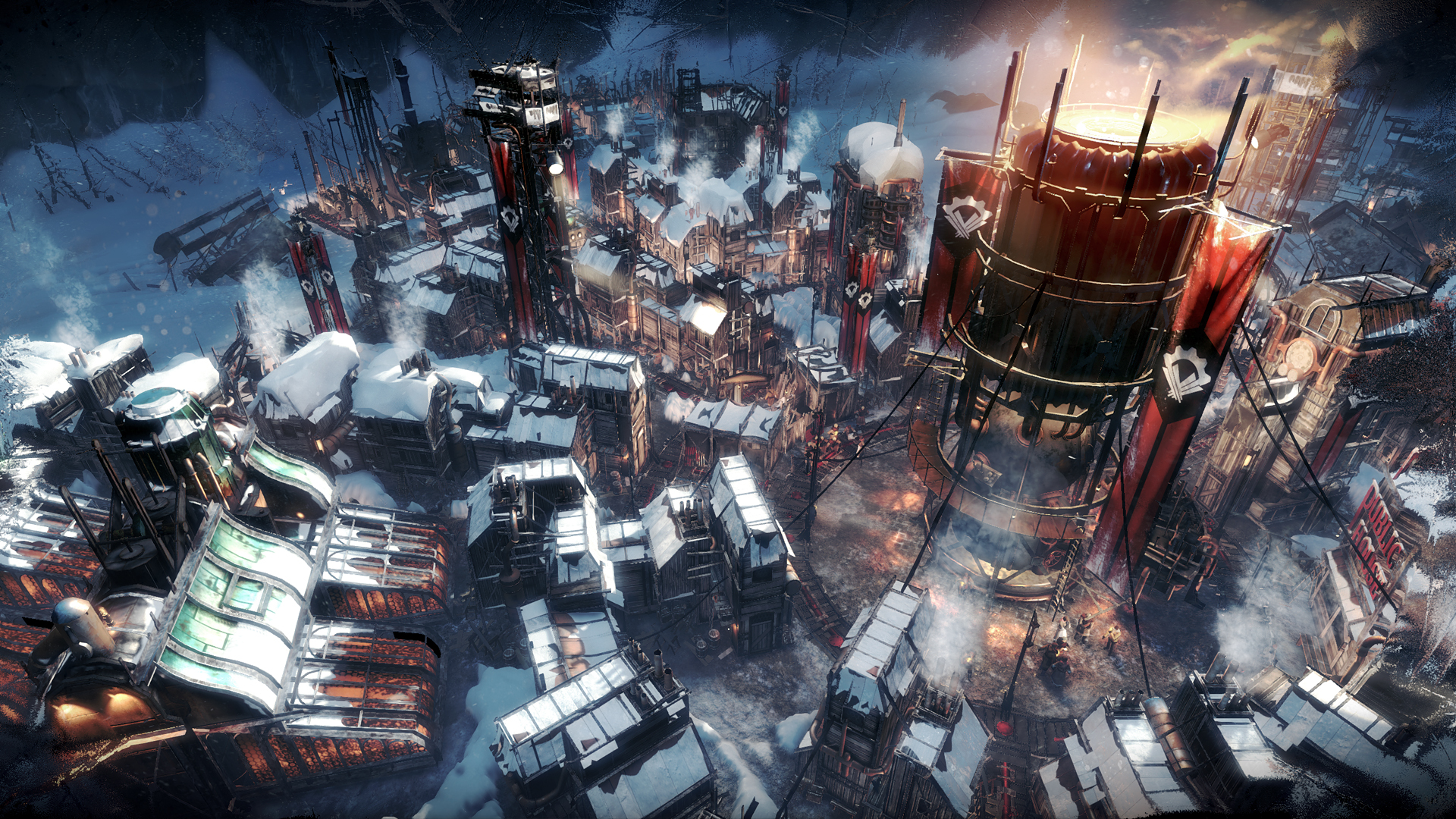
11 bit studios built Frostpunk around a question that most strategy games sidestep: not whether you can win, but what you are willing to do to win. The city you manage is freezing. Coal is running low. Children are starving. And the game hands you the tools to fix all of that — child labour laws, forced work shifts, public executions — and then watches your face while you use them. It is not subtle. It does not need to be.
Released in 2018 and still generating conversation years later, Frostpunk sits in an awkward genre space between city-builder and survival management. That awkwardness is intentional and mostly works in its favour. You are never just optimising a spreadsheet, because the people in that spreadsheet keep dying and you keep having to explain why to yourself, alone, at your desk at eleven at night.
The generator is not a metaphor. Or maybe it is.
The central structure of A New Home — the main scenario, and the best place to start — is a countdown. You know a massive storm is coming. You know roughly when. Everything you build and research and legislate is in service of surviving that single event. That clarity of purpose is one of the sharpest design decisions in the game; it removes the aimless drift that plagues a lot of city-builders and replaces it with dread. You are not growing. You are bracing.
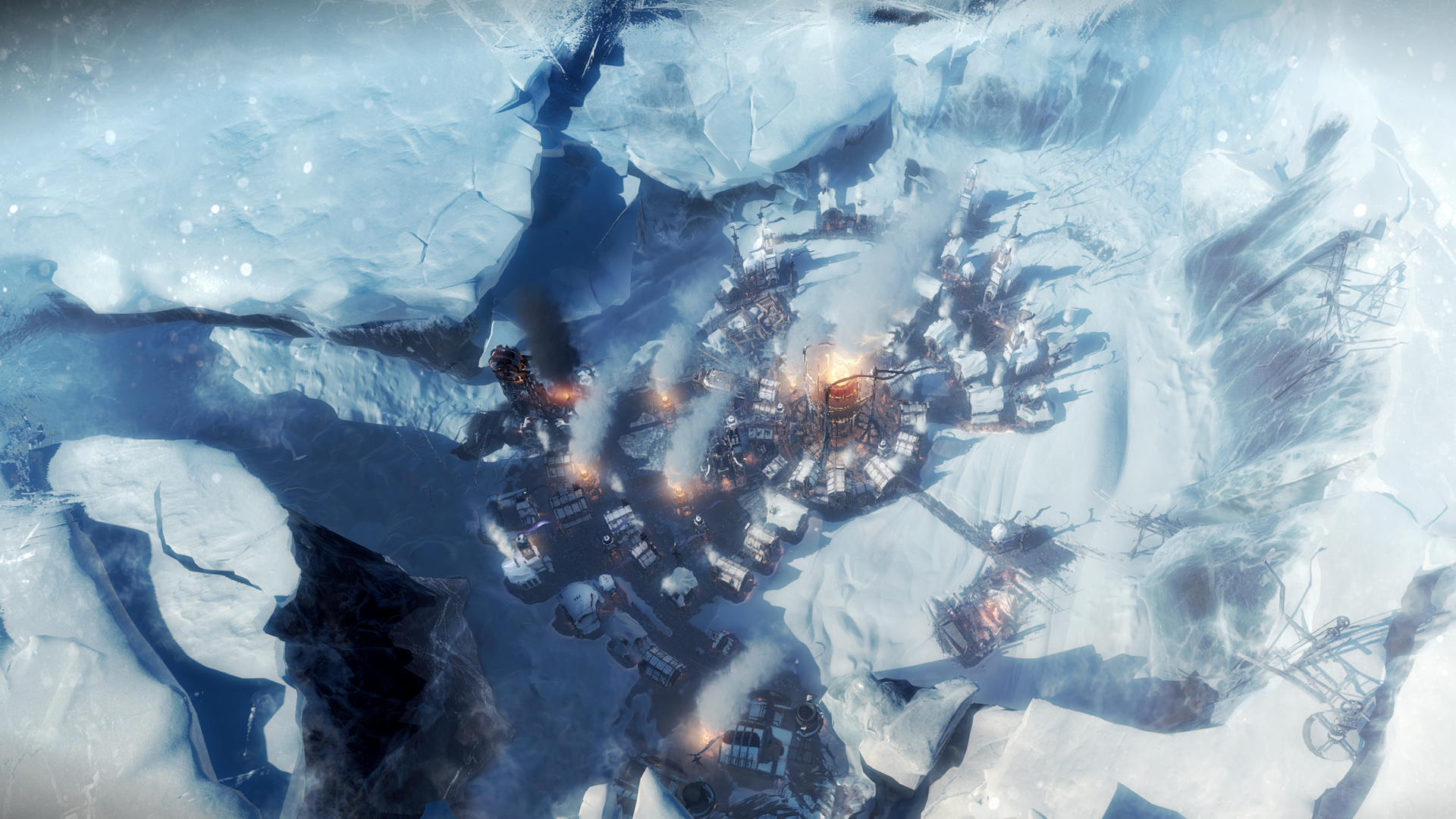 Atmospheric detail in Frostpunk.
The generator at the city's centre needs to be upgraded through a research tree divided into steam-powered infrastructure, medical facilities, and industrial output. You do not have time to research everything before the storm hits, which means every choice forecloses another. Taking the Overdrive ability for the generator, which pushes heat output past safe limits and risks breakdowns, feels like a genuine decision rather than a mechanical toggle. The cost is real and legible — you can watch your engineers walk into a hot core and not all of them walk back out.
None of this is gamified abstraction. The research tree communicates scarcity through its layout, not through pop-up warnings. You feel the bottleneck before the numbers confirm it.
Laws, not combat
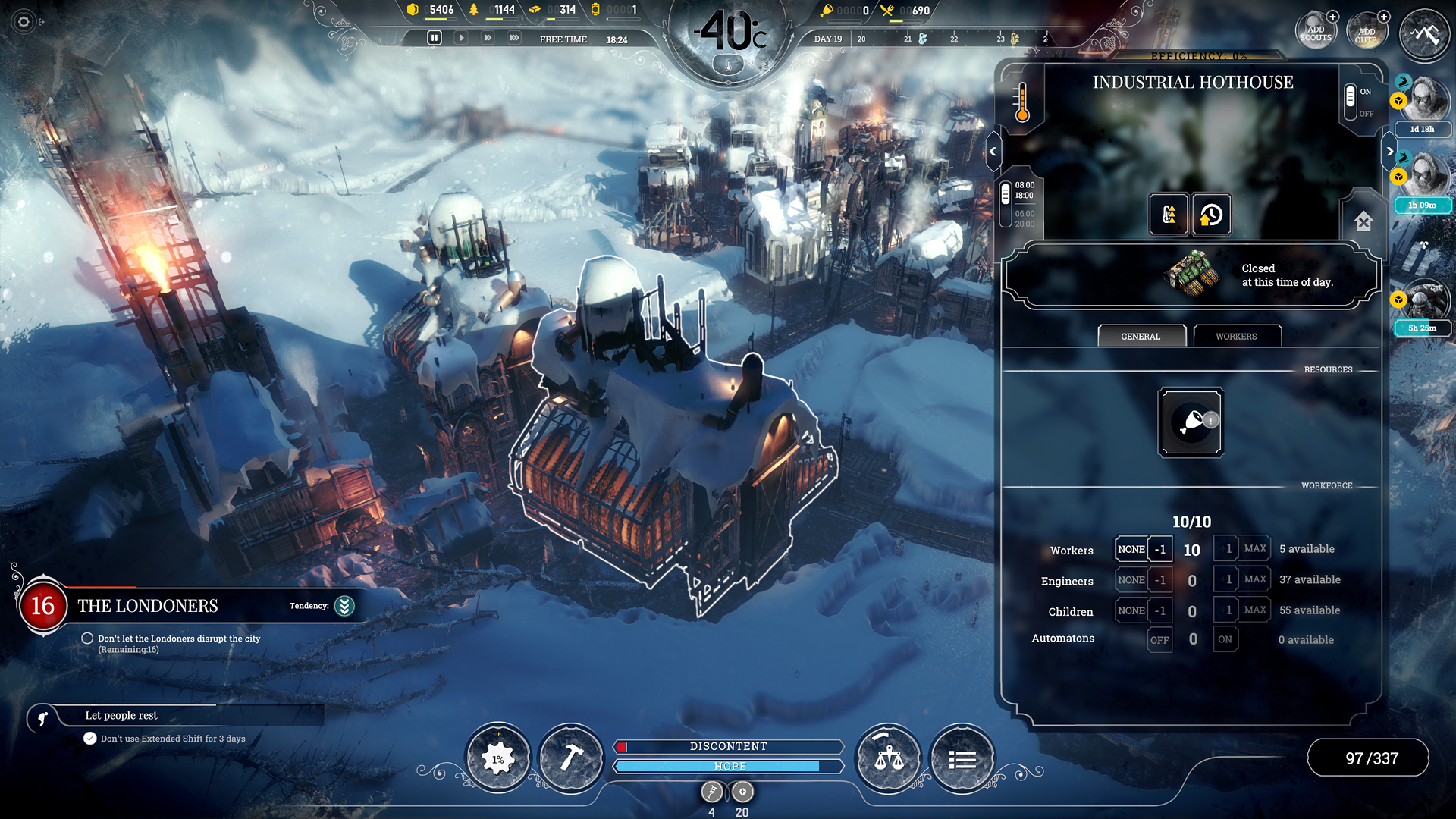
There is no combat in Frostpunk. That absence shapes everything. The tension that other strategy games discharge through battle accumulates here instead, channelled entirely into governance. The Book of Laws is the game's real weapon system. You sign legislation through it — extended shifts, child labour, corpse disposal protocols, faith propaganda — and each law carries a social cost measured in two meters at the top of the screen: Hope and Discontent.
 Combat encounter in Frostpunk.
Let Hope drain too far and your people give up. Let Discontent spike too high and they revolt. Managing these two bars is the actual game, and it is nastier than it sounds because the laws that help you survive fastest are exactly the laws that shred your moral standing. The game never tells you that you are a bad person. It just shows you the legislation you signed and the current population count and leaves you to connect those dots.
What keeps this from feeling manipulative is that 11 bit gave you real alternatives. You can survive A New Home without signing the harshest laws, though it is significantly harder. The game earns its grimness by making it optional. The monster is a path, not a rail.
The scenarios that follow — and why The Arks is the best of them
Frostpunk ships with three additional scenarios beyond A New Home, plus the Endless Mode that strips out narrative for pure systems play. The Refugees and On The Edge came later via DLC. Each scenario runs a different premise through the same engine, which reveals both how flexible the base systems are and where they start to show wear.
The Arks — where you protect greenhouses containing the last of Earth's seeds — is the strongest of the lot. Its layout forces you to think about heat distribution differently: your buildings must cover irregular seed vault locations rather than radiating cleanly outward from a central generator. The spatial puzzle changes how even familiar choices feel. You are running the same research tree with the same coal concerns, but the map fights you in a different way, and the thematic weight of preserving life rather than just sustaining it adds a layer that A New Home, focused on sheer endurance, does not quite reach.
On The Edge, part of the Season Pass content, adds a supply chain element and a more complex political relationship with an outside settlement. It is the most mechanically ambitious scenario, though it occasionally drowns its own tension in logistics. When you are counting delivery routes, you are not watching people die, and that distance costs the game something.
What the UI is quietly doing
A lot of the game's emotional weight is delivered through interface decisions that you only notice if you stop and look. Clicking on a building shows you the workers assigned to it. Clicking on a worker shows you their name, their health status, whether they are sick, whether their family is dead. Most players will not click on individual workers most of the time. But knowing that information is there — knowing these are named individuals, not population tokens — changes how the aggregate numbers feel.
The sign-off moment when you pass a law deserves specific mention. A popup appears describing what the law means in plain language, and you have to actively confirm it. There is a small pause built into that confirmation. Nothing graphically dramatic happens. The game just makes you sit with the sentence 'Children aged 13 and above may now be employed in dangerous conditions' for a moment before it takes effect. That is extremely good design. It costs nothing technically and accomplishes a great deal.
Where it loses grip
Frostpunk is not a perfect machine. The mid-game of A New Home can stall badly if your coal situation is well under control — there is a stretch of two to three in-game days where you have optimised enough to be comfortable but the storm is still far enough away that tension evaporates. Some players will use that window to refine their city layout. Others will start browsing their phone. The game has no reliable mechanism for filling that lull.
Scout expeditions, where you send teams out onto the frozen map to retrieve survivors and resources, are meant to provide a secondary loop of discovery. They do this moderately well early on. But the scout events are text-based and relatively shallow — a few lines of flavour and a binary choice — and they cannot carry the weight the game places on them during quieter stretches. Something in the vein of what Sunless Sea does with its port encounters, with more variation and consequence, would have made those quiet hours considerably sharper.
The ending argument
A New Home ends with a summary screen that lists every law you passed, every person you lost, and the current state of your city. It reads like an audit. The game does not grade you with a letter or a star rating. It just shows you what happened and what you decided. The implicit comparison is to the run you wish you had done.
This is where Frostpunk earns its reputation, and why strategy games that have tried to replicate its formula — Surviving the Aftermath included — have generally missed the point. The mechanics are not especially complex. The map is small. The scenarios run a few hours each. What 11 bit built is not a deep simulation; it is a designed emotional experience wearing a simulation's clothes. The coal runs out. The people suffer. You signed the law that let them suffer, because otherwise they would have frozen, and you told yourself that was different.
Whether you believe yourself is the part that lingers.
Editorial scoring
Reader Q&A
How long does it take to finish Frostpunk makes you the monster keeping everyone alive?
Main story runs around 18 hours depending on how thoroughly you explore. Completionists can spend 2-3× that.
Is Frostpunk makes you the monster keeping everyone alive good for newcomers to Survival City-builder?
It depends. The systems are deep but the tutorial does a fair job. Veterans of Survival City-builder will feel at home faster.
Which platform should I play Frostpunk makes you the monster keeping everyone alive on?
Steam Deck handles this title well — verified compatibility on most recent patches.
Was Frostpunk makes you the monster keeping everyone alive worth the launch-day price?
If you're a fan of 11 bit studios, yes. If you're new to the studio, a sale price is more comfortable.
Are there DLCs or expansions worth picking up?
Wait for the Game of the Year edition — it bundles everything at a fair discount.
What did 11 bit studios get right (and what could be better)?
11 bit studios nailed the moment-to-moment loop and the world-building. Pacing in the mid-game and inventory UX have room for improvement.
Reader comments