Cult of the Lamb is adorable, devout, and quietly ruthless
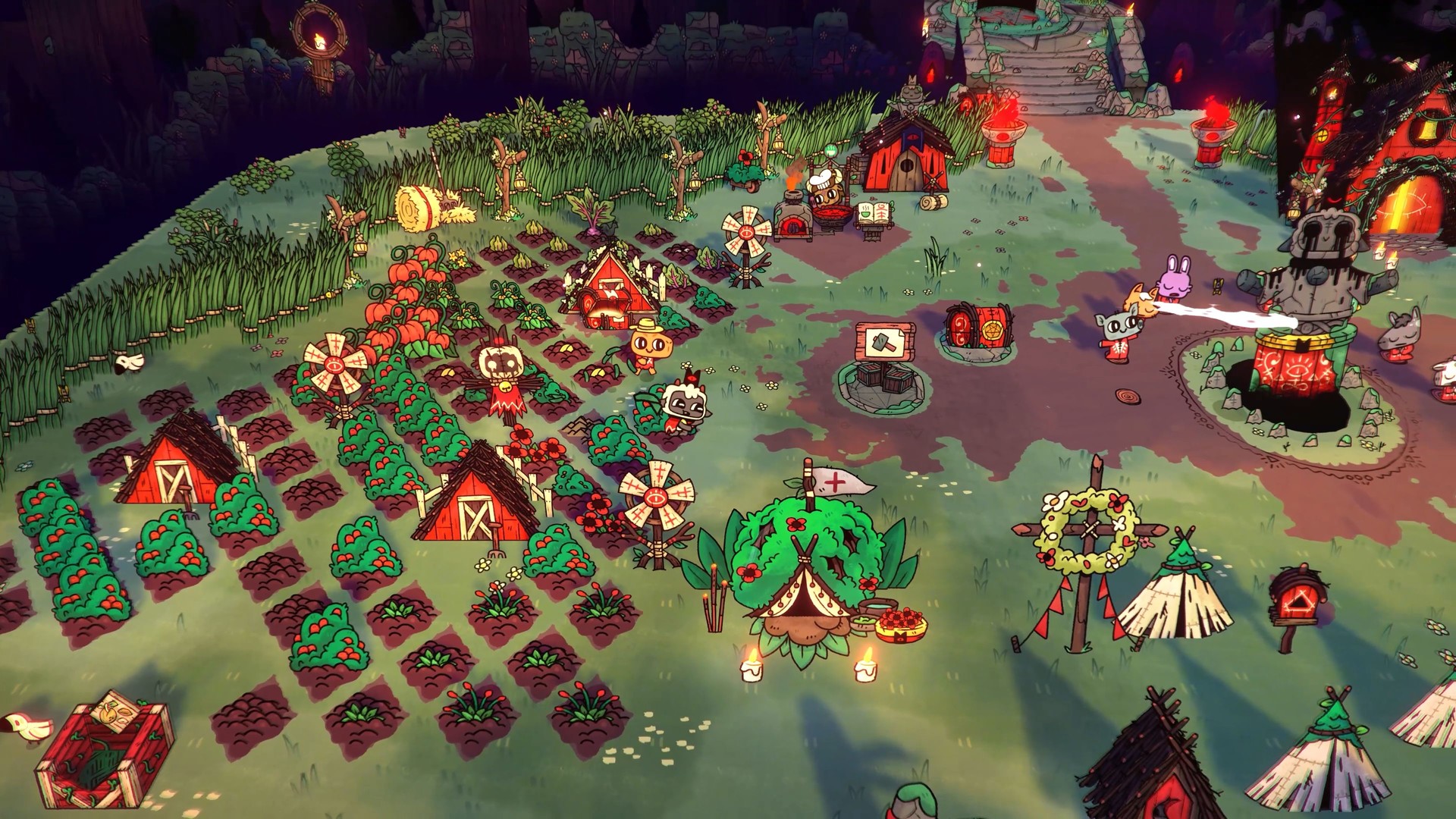
Cult of the Lamb wants you to feel two things at once: tender affection for the small woolly creature you control, and low-grade unease about what that creature is actually doing. Massive Monster leans into this dissonance hard. The pastel palette, the rounded character designs, the cheerful sound effects when a follower completes their chores — all of it is doing work, covering for a management loop that is, beneath the surface, pretty grim. You are building a cult. You are indoctrinating believers, extracting their labor, and occasionally feeding them mushroom stew of dubious origin. The game knows this and enjoys it.
Released in August 2022, the game sits at an unusual intersection: part roguelite dungeon crawler, part colony management sim, with just enough of each to satisfy fans of neither genre entirely. That sounds like a criticism, but it is more of an observation about the game's ambitions. Massive Monster is an Australian studio working at a scale most indie teams would find daunting, and Cult of the Lamb mostly holds together. Mostly.
The dungeon runs, explained plainly
Each crusade — the game's term for a run — takes you through one of four regions, each controlled by a Bishops of the Old Faith you are working toward defeating. The combat is real-time, room-based, and built around a dodge-roll rhythm that will feel familiar to anyone who has spent time with Enter the Gungeon or Hades. You clear rooms, collect tarot cards (passive upgrades), find weapons, and accumulate resources to bring back to your commune. The loop is not especially novel.
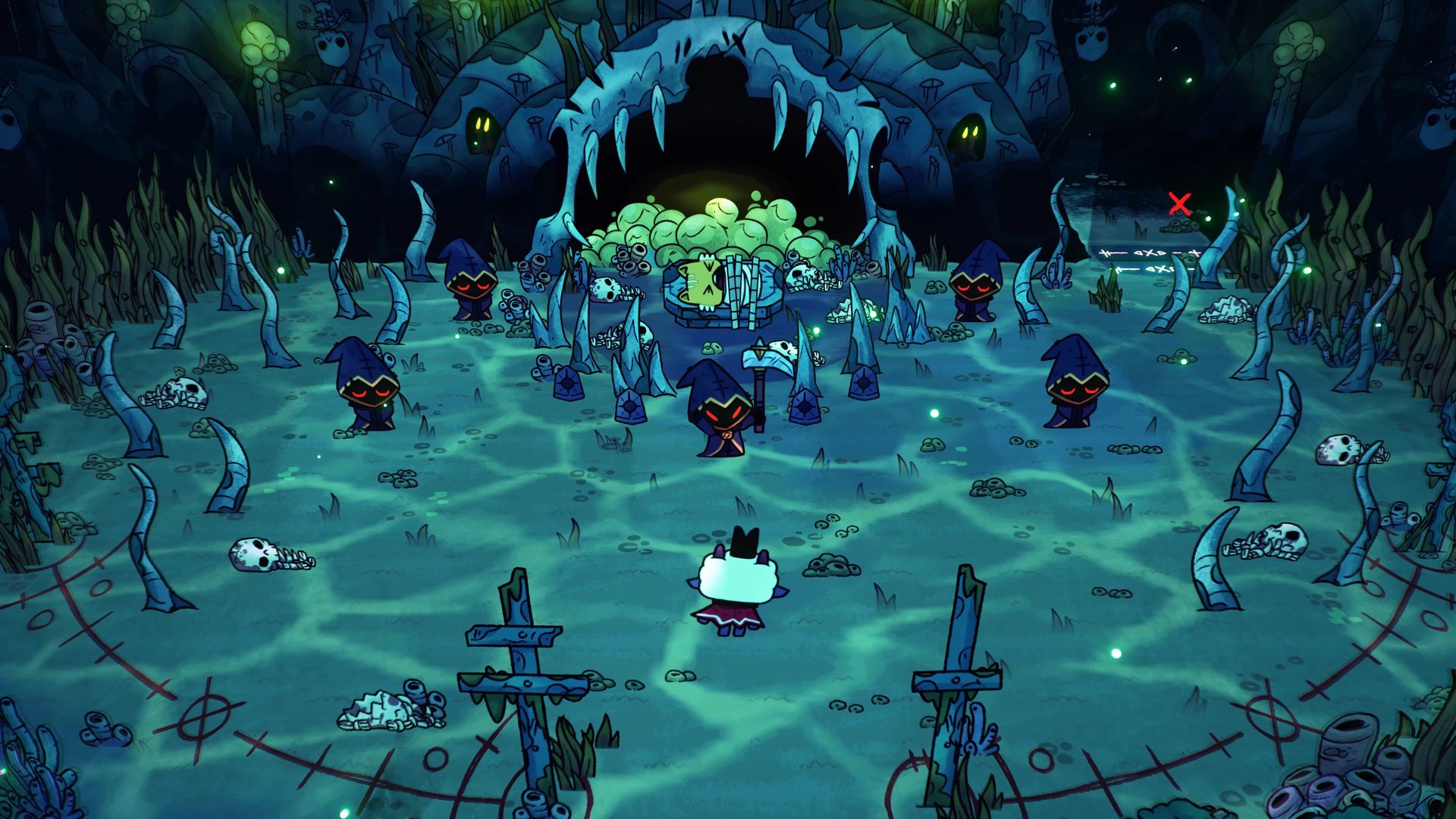 Atmospheric detail in Cult of the Lamb.
What distinguishes it is pacing. The runs are deliberately short — rarely more than twenty or twenty-five minutes if you know what you are doing. That brevity is intentional. Massive Monster wants you cycling back to camp regularly, because camp is where the other half of the game lives. The dungeon sections serve as resource procurement missions as much as combat challenges. You fight because you need lumber, stone, and devotion to keep your followers fed and faithful.
The weapon variety is solid if not exceptional. Axes, swords, daggers, and a handful of ranged options each handle differently, and the tarot card system can push any of them into unexpected territory. A slow axe paired with a card that adds poison on heavy attacks plays very differently from the same axe without it. The system does not reach the build depth of Hades' weapon aspects or Dead Cells' mutation chains, but it gets the job done.
Running a cult is where the hours go
The base-building is genuinely engaging for longer than you would expect. Followers need food, shelter, spiritual reinforcement, and somewhere to relieve themselves (no, really — waste management is a mechanic, and neglecting it spreads illness through your commune). You assign them tasks, unlock sermons to boost devotion, perform rituals that impose doctrine on the group, and slowly transform a scrubby patch of forest into something resembling a functioning settlement.
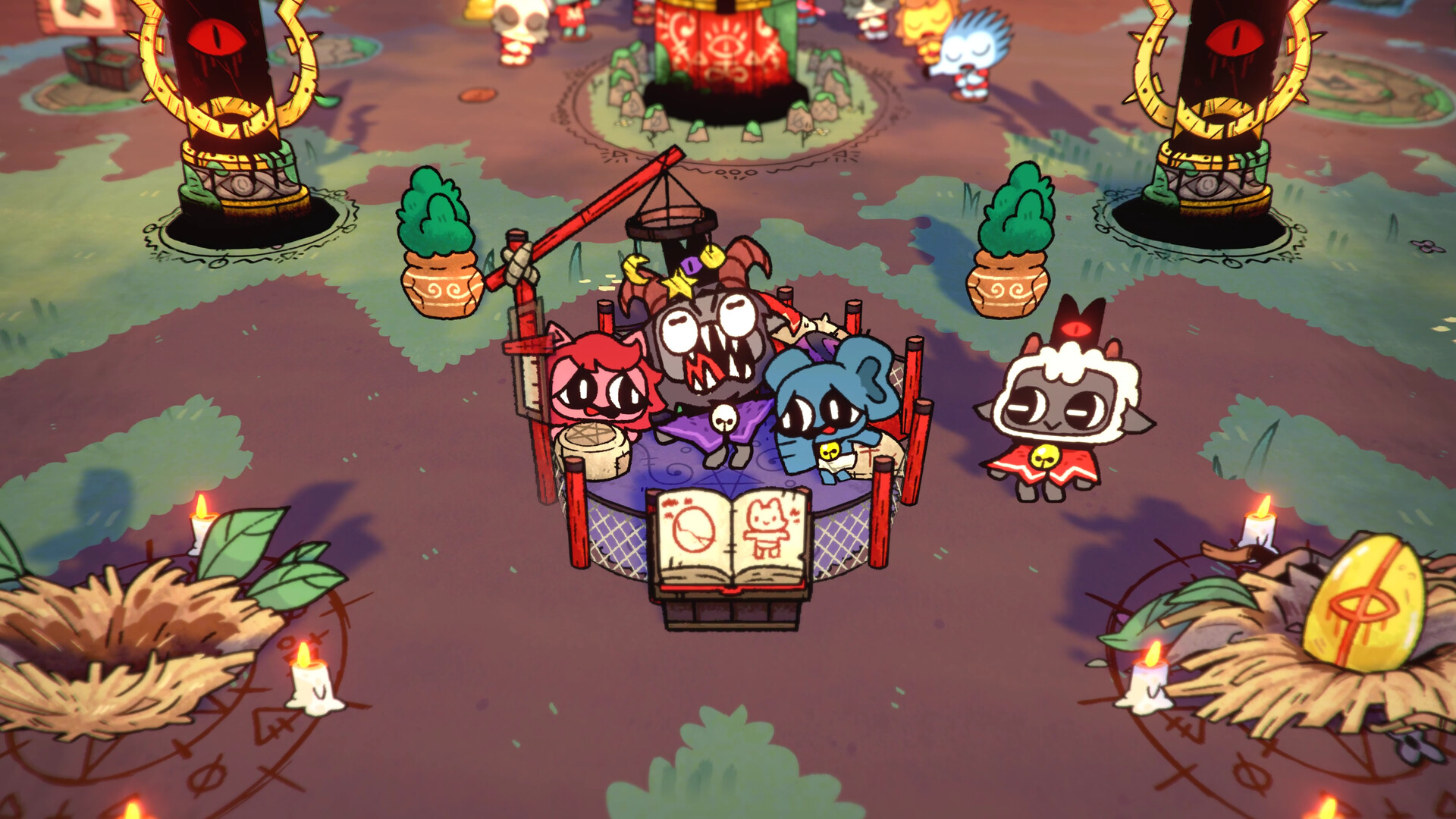 Combat encounter in Cult of the Lamb.
The doctrine system is worth spending time on. As you level up your cult, you choose from pairs of tenets that shape how your followers behave and what they believe. Some are straightforwardly beneficial. Others introduce tradeoffs — permitting cannibalism, for instance, solves food shortages but generates unrest and sick followers if overused. The game never forces a particular doctrine path, which means you can run a relatively benign commune or something considerably darker. That flexibility is a genuine design strength.
There is one friction point that never quite resolved itself for me: follower loyalty is somewhat arbitrary. Followers age and die regardless of your care, which is fine thematically, but the rate at which new arrivals join and old ones leave can make the mid-game feel like treading water. You spend time rebuilding the same devotion levels instead of expanding, and the management tasks — especially the daily ritual sermon — become rote faster than the combat does.
Art direction as a design argument
Cult of the Lamb has one of the more coherent visual identities in recent indie releases. The character designs pull from a lineage that includes Animal Crossing and Don't Starve without looking like either. Everything is expressive, clean, and immediately readable — you can tell at a glance when a follower is hungry, sick, or losing faith, which matters when you are managing upward of twenty of them. This is art direction solving a practical problem, not just looking good.
The four dungeon regions are visually distinct in biome and enemy design, though they blur a little after extended play. Silk Cradle, the fourth region, feels meaningfully different from Darkwood in both enemy behavior and environmental texture. The boss designs are strong across the board — each of the four bishops has a readable attack language, and the final confrontation is staged well enough to feel like a proper conclusion rather than a difficulty spike.
Where Massive Monster overreaches
The game's weakest area is its secondary content — fishing, the tavern mini-game, and a handful of other activities unlocked through follower interactions. None of them are broken, but most of them feel like padding dressed up as progression. The fishing mechanic in particular is a brief distraction at best. Compare it to the fishing in Stardew Valley, where the minigame has genuine tension, or even Dredge, where casting a line ties directly into the main loop's sense of dread. In Cult of the Lamb, it just sits there.
The post-launch updates — Relics of the Old Faith and Unholy Alliance, both free — added co-op and a significant amount of new content, addressing some of the mid-game thinness. The co-op implementation is functional but uneven. Having two players share one commune while taking separate paths through dungeons is a clever structural idea, but the camera struggles with the split-focus management tasks, and the shared resource economy can create friction rather than cooperation depending on how aligned your playstyles are.
There is also a difficulty curve problem that the game never fully solves. The early crusades are notably harder than the mid-game, which inverts the expected trajectory. Once your commune reaches a certain size and your follower bonuses stack, the dungeon sections stop being threatening. The final boss is appropriately challenging, but the regions leading to it can feel like maintenance runs. For a game with roguelite DNA, that loss of tension in the dungeon half is a real cost.
What it actually is, and whether that is enough
Cult of the Lamb is not the deepest colony sim, and it is not the tightest roguelite. What it is, more precisely, is a game that understands tone. The way it holds humor and menace in the same frame — a follower joyfully completing a sermon before being quietly sacrificed for a ritual upgrade — is specific and deliberate. That tonal control carries it through the stretches where the individual systems would not hold attention on their own.
Massive Monster made something that is easier to recommend than to fully defend. The cracks are real. The dungeon progression loses urgency too early, the secondary activities do not earn the time they ask for, and there are management systems that needed one more pass before shipping. But the core fantasy — building something, believing in something, and watching your small congregation grow into a functioning (if morally compromised) community — lands. That is harder to pull off than it looks, and the studio deserves credit for getting there even if the path has some rough edges.
If you have been sitting on this one since launch, the post-update version is the right version to play. It will not convert you if the aesthetic is not your thing, and it will not satisfy the part of you that wants either half of the game pushed harder. But if you can meet it where it lives — somewhere between a management puzzle and a dark fable with good music — Cult of the Lamb earns its hours.
Editorial scoring
Reader Q&A
How long does it take to finish Cult of the Lamb is adorable, devout, and quietly ruthless?
Main story runs around 47 hours depending on how thoroughly you explore. Completionists can spend 2-3× that.
Is Cult of the Lamb is adorable, devout, and quietly ruthless good for newcomers to Roguelite Cult Sim?
It depends. The systems are deep but the tutorial does a fair job. Veterans of Roguelite Cult Sim will feel at home faster.
Which platform should I play Cult of the Lamb is adorable, devout, and quietly ruthless on?
PC version offers the highest fidelity if your rig can handle it. Console versions are polished out of the box.
Was Cult of the Lamb is adorable, devout, and quietly ruthless worth the launch-day price?
If you're a fan of Massive Monster, yes. If you're new to the studio, a sale price is more comfortable.
Are there DLCs or expansions worth picking up?
Wait for the Game of the Year edition — it bundles everything at a fair discount.
What did Massive Monster get right (and what could be better)?
The systems are confident and the combat is satisfying. The story handoffs and load times are the rough spots.
Reader comments